





Adult eczema at night often feels worse because dry, inflamed skin, normal nighttime changes in skin function, warmth, and scratching reinforce one another. A short lukewarm wash when needed, prompt moisturizing, cooler bedding, and your prescribed eczema treatment can help; repeated waking means your treatment plan needs attention, not just another skincare product.
- Eczema at night needs both skin-barrier care and control of inflammation; moisturizer alone does not replace prescribed treatment.
- Keep bedtime cleansing brief and lukewarm, then moisturize while skin remains slightly damp.
- Rejûvaskin eczema care separates rinse-off cleansing from leave-on moisturizing; neither step cures eczema.
- Seek medical assessment for spreading redness, increasing pain, pus, fever, or painful blisters.
Why does adult eczema itch more at night, and what helps?
Nighttime itching is not evidence that you need to wash more. Eczema affects the skin barrier and involves inflammation; vigorous cleansing can add irritation rather than solve the problem. If bathing triggers your evening symptoms, start with the related guide to why eczema itches after a shower.
Use this 2026 care checklist to match the problem with the next step. These measures support eczema care, but they do not identify every cause of nighttime itching.
| What you notice | What can contribute | Best for: next step | Important limit |
|---|---|---|---|
| Tight, dry skin after washing | Hot water, irritating cleanser, or delayed moisturizing | Post-wash dryness: shorten washing and moisturize promptly | Persistent inflammation still needs treatment |
| Itching under heavy bedding | Heat, sweating, and friction | Overheating: use lighter, breathable layers | Cooling does not treat an active flare |
| Scratching as you fall asleep | Itch becomes harder to ignore without daytime distractions | Habit-related scratching: keep nails smooth and press rather than scratch | Scratching during sleep is not fully voluntary |
| Repeated waking despite skincare | Eczema that is not adequately controlled | Ongoing sleep loss: arrange a treatment review | Do not keep adding products instead of seeking care |
Why does nighttime itching matter beyond an uncomfortable evening?
Broken sleep is a treatment concern, not a cosmetic issue. Scratching can damage already vulnerable skin, while tiredness makes a consistent care routine harder to maintain.
Your goal is more than getting through bedtime. You need a routine that limits avoidable irritation and a medical plan that controls the underlying eczema. If sleep remains disrupted, tell your clinician explicitly rather than reporting only that your skin is dry.
Why does eczema itching vary from one night to another?
Several factors can overlap. A difficult night does not prove that one food, ingredient, or household item caused your flare.
- Skin-barrier dryness: Eczema-prone skin loses moisture readily. Dryness can leave skin feeling tight and itchy, particularly after washing.
- Daily biological rhythms: Skin temperature, barrier function, and inflammatory signaling change across the day. These rhythms help explain nighttime symptoms but do not diagnose their cause.
- Heat and sweat: Heavy bedding, warm sleepwear, and an overheated room can aggravate itching in susceptible skin.
- Friction and irritants: Rough seams, fragranced products, or detergent residue can make contact with inflamed skin uncomfortable.
- Attention and scratching: Without daytime distractions, itching becomes more noticeable. Scratching then adds irritation and perpetuates the itch–scratch cycle.
- Uncontrolled inflammation: Moisturizing supports the barrier, but an active flare can require prescribed anti-inflammatory treatment.
Avoid treating this list as a reason to change everything at once. Start with an obvious problem, such as hot showers or heavy bedding, and keep the rest of your routine familiar.
What should you do before bed to reduce eczema at night?
A useful 2026 bedtime routine is short enough to repeat when you are tired. Keep prescribed treatment in the plan, and avoid turning a flare into an experiment with several unfamiliar products.
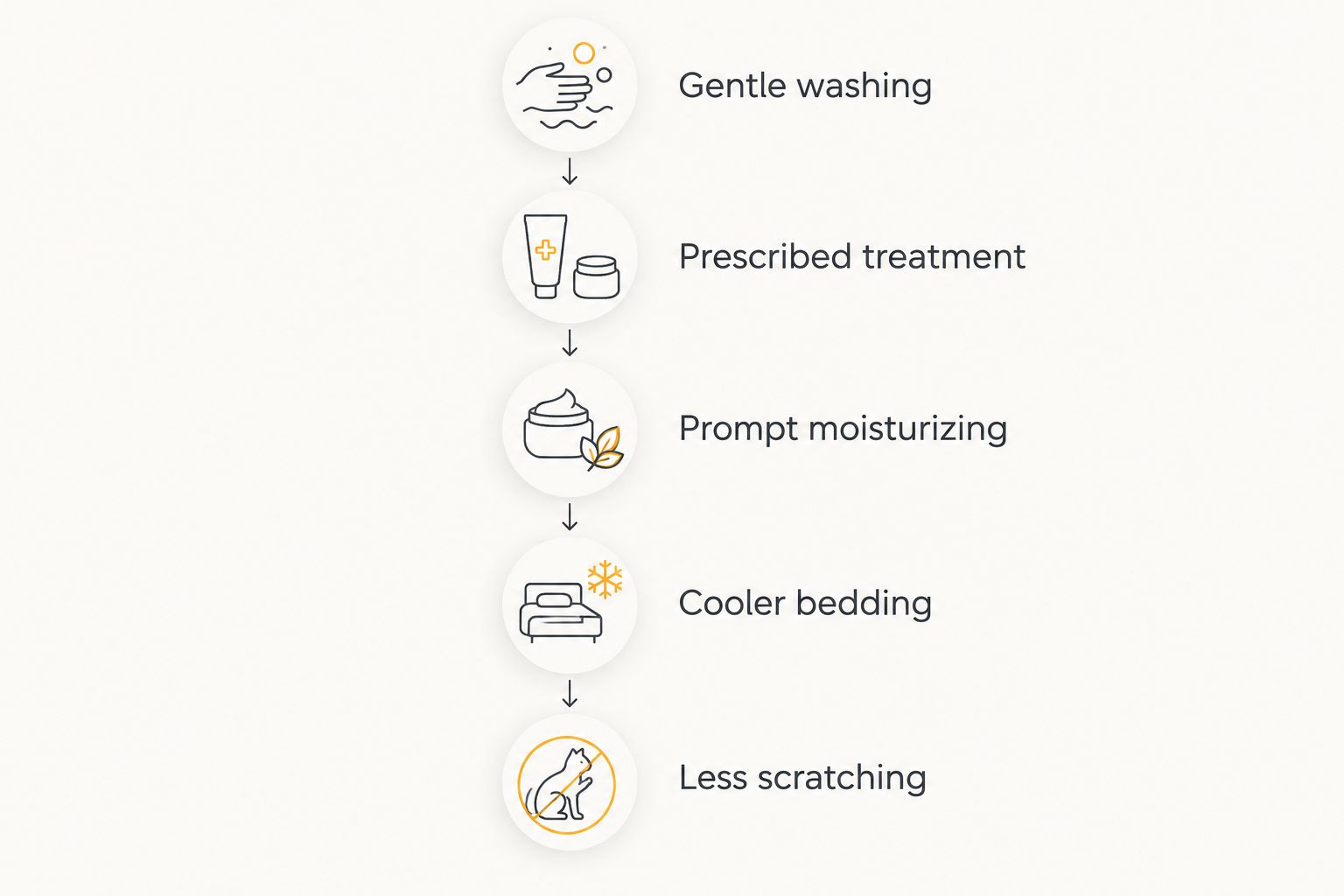
1. Gentle washing
If you bathe before bed, use lukewarm water rather than hot water. The National Eczema Association’s bathing guidance recommends short bathing, generally 5–10 minutes, followed by moisturizing.
Choose a gentle cleanser appropriate for eczema-prone skin, and avoid scrubs or abrasive washcloths. You do not need to scrub itchy patches clean; eczema is not caused by poor hygiene. Rinse away the cleanser and pat rather than rub with a soft towel.
2. Prescribed treatment
Apply prescribed topical treatment according to your clinician’s instructions, including the body areas, amount, and treatment schedule. Different medicines have different directions, so there is no universal bedtime layering rule.
If you are unsure how to combine medication and moisturizer, ask your pharmacist or prescriber. Do not stop a prescribed steroid because you have added a moisturizer, and do not extend treatment beyond the prescribed plan without advice.
3. Prompt moisturizing
Apply a tolerated moisturizer while your skin is still slightly damp. The National Eczema Association’s moisturizing guidance explains the role of regular moisturizing in supporting the skin barrier and recommends applying moisturizer after bathing.
Choose fragrance-free products rather than assuming that an unscented label means no fragrance ingredients. If a product produces persistent burning, worsening redness, or a new rash, stop using it and seek advice rather than repeatedly applying it to the same irritated area.
4. Cooler bedding
Choose comfortable, breathable sleepwear and bedding that do not trap excessive heat. Remove an unnecessary layer if you wake sweaty, and avoid rough fabric directly against active eczema.
There is no single bedroom temperature that suits every adult with eczema. Aim for comfort without sweating rather than chasing a precise thermostat setting.
5. Less scratching
Keep fingernails short and smooth to reduce damage from scratching. When you are awake, try gentle pressure or a brief cool, damp compress instead of rubbing itchy skin; do not place ice directly on eczema.
Keep your usual moisturizer within reach so nighttime care stays simple. If you wake repeatedly, record that pattern for your clinician rather than assuming that more frequent product application will solve it.
Where do a body wash and moisturizer fit into the routine?
Rejûvaskin eczema skincare is for adults seeking separate cleansing and moisturizing steps alongside their treatment plan. The distinction matters: a rinse-off cleanser does not provide the same ongoing skin protection as a leave-on moisturizer.
| Product | Role and stated ingredients | Best for | Limitation |
|---|---|---|---|
| Eczema Body Wash | Rinse-off cleanser with 2% colloidal oatmeal and sodium hypochlorite | Adults seeking a cleanser formulated for eczema-prone skin | Does not replace moisturizer or treat a suspected infection |
| Skin Recovery Cream | Leave-on moisturizer and skin protectant with 6% dimethicone, aloe vera, calendula, and hyaluronic acid | Adults seeking leave-on support for dry, sensitive skin | Does not replace prescribed anti-inflammatory treatment; individual tolerance varies |
Both products carry National Eczema Association acceptance according to the brand catalog. Acceptance does not guarantee that every person will tolerate every ingredient, and general guidance about moisturizing is not product-specific proof of nighttime itch relief.
The presence of sodium hypochlorite in Rejûvaskin Eczema Body Wash is not a reason to add household bleach or make a homemade mixture. Follow the product label; suspected infection needs medical assessment, not extra cleansing.
The product photos below identify the two different steps. For your 2026 routine, choose according to the task you need rather than expecting either product to handle cleansing, inflammation, and sleep disruption by itself.


Can moisturizer alone stop eczema itching at night?
Moisturizer alone does not reliably control an inflamed eczema flare. It supports the skin barrier, but persistent redness, itching, and sleep disruption warrant a review of your treatment plan.
Keep using your prescribed treatment as directed. If it is not helping, tell your clinician what you used, where you applied it, and whether discomfort or complicated instructions made it difficult to follow the plan.
Should you take an antihistamine to sleep through eczema itching?
Antihistamines are not a substitute for eczema treatment, and sedating products are not an automatic solution for nighttime itching. Ask a clinician or pharmacist before using one for sleep, especially if you take other medicines or need to drive the next morning.
Do not combine sedating medicines with alcohol or other sleep aids without professional guidance. Treating inflammation and investigating persistent sleep disruption remain the priorities.
When is nighttime itching a reason to seek medical care?
Repeated waking is enough reason to arrange an eczema review, even without signs of infection. You do not need to wait until scratching causes open wounds or exhaustion affects your work.
Seek prompt medical assessment for:
- Increasing pain, warmth, swelling, or spreading redness.
- Pus, new crusting, or a sudden change in drainage.
- Fever, feeling unwell, or rapidly worsening skin symptoms.
- Painful clusters of blisters or new punched-out sores, especially near the eyes.
Painful blisters or rapidly spreading sores need urgent assessment because eczema herpeticum is a medical emergency. Do not cover concerning symptoms with additional skincare and wait for them to settle.
The American Academy of Dermatology’s weeping eczema guidance addresses fluid leakage, possible complications, and when medical evaluation is needed. Weeping does not automatically mean infection, but a change in your usual eczema deserves attention.
New nighttime itching without your usual eczema pattern also needs assessment. Other skin conditions can itch at night, so timing alone cannot confirm eczema.
What should you tell your clinician about nighttime symptoms?
Bring a brief record to your 2026 appointment: where itching occurs, whether it starts after washing or under bedding, and whether you wake scratching. Note new products and any visible changes in the rash.
Include the names of prescribed and nonprescription treatments you actually use. A photograph of a changing patch can help describe its appearance, but it cannot replace examination when infection or another diagnosis is a concern.
Ask for a clear flare plan and a maintenance plan. You should know what to apply, when to reassess, and whom to contact if sleep continues to suffer.
What does the guidance support—and what does it not prove?
The NEA bathing and moisturizing resources cited here are patient-care guidance about cleansing and barrier support. The AAD resource addresses weeping eczema and its management; it does not establish why an individual adult itches at night.
These guidance pages are not presented as new 2026 research, and no publication date is assigned here where one is not established. General recommendations do not prove that a particular wash or cream prevents waking, treats infection, or controls every eczema flare.
The same limit applies to ingredient percentages. A cleanser containing 2% colloidal oatmeal and a cream containing 6% dimethicone serve different purposes; their percentages are not a head-to-head measure of effectiveness.
FAQ
Why does my eczema itch more as soon as I get into bed?
Warm bedding, friction, dry skin, and fewer distractions can make eczema itching more noticeable in bed. Nighttime changes in skin function also contribute, but the timing alone does not identify your trigger.
Should I shower before bed if I have eczema?
You can shower before bed if your skin tolerates it and the routine fits your treatment plan. Use lukewarm water, keep washing brief, and moisturize while your skin remains slightly damp.
Should I put more eczema cream on every time I wake up?
Do not repeatedly apply medicated eczema cream beyond its prescribed directions. A tolerated moisturizer serves a different role, but frequent waking still warrants a treatment review.
Can Rejûvaskin Eczema Body Wash replace my nighttime moisturizer?
Rejûvaskin Eczema Body Wash cannot replace a leave-on moisturizer because it is a rinse-off cleanser. Follow cleansing with a tolerated moisturizer and keep prescribed eczema treatment in your routine.
Does the National Eczema Association seal mean a product cannot irritate me?
National Eczema Association acceptance does not guarantee individual tolerance. Check the full ingredient list and stop a product that causes persistent burning, worsening redness, or a new rash.
Is weeping eczema always infected?
Weeping eczema is not always infected, but new drainage, increasing pain, warmth, pus, or fever needs medical assessment. Do not try to treat suspected infection by washing more often.
When should I see a doctor for eczema at night?
See a clinician when eczema at night repeatedly interrupts sleep or remains uncontrolled despite following your treatment plan. Seek urgent assessment for painful blisters, rapidly spreading sores, or symptoms near the eyes.
One last thing
Track waking, not just redness. Skin that looks less inflamed can still leave you scratching and exhausted; that mismatch is useful information for your clinician, not a reason to dismiss your symptoms.
Keep your bedtime routine simple enough to repeat. Better eczema care means removing avoidable irritation while getting the inflammation treated—not proving that you can tolerate another sleepless night.
Educational information only. This article does not diagnose eczema or replace individualized medical advice. Follow product labels and your clinician’s treatment instructions.